


Wireless communication has traditionally depended on radio frequencies, with Wi-Fi becoming an essential part of homes, offices, schools, airports, hospitals, and public spaces. However, growing demand for faster connections, lower latency, stronger security, and greater network capacity is encouraging researchers and technology companies to explore alternatives. One of the most interesting developments is Light Fidelity, commonly called LiFi.
LiFi is a wireless communication technology that uses light rather than conventional radio waves to transmit information. Compatible LED light sources can rapidly change their intensity in ways that are too fast for the human eye to notice. A receiver interprets these variations as digital information, allowing data to travel through illumination.
According to revolvertech, the importance of LiFi goes beyond simply creating another alternative to Wi-Fi. Its real potential comes from combining lighting and high-speed communication into a single infrastructure. As connected environments become more crowded with devices, LiFi could provide an additional layer of wireless capacity while opening opportunities for highly controlled communication zones.
How LiFi Technology Works
The basic principle behind LiFi is relatively straightforward, even though the underlying engineering can be sophisticated. An LED lamp acts as an optical transmitter. Instead of continuously emitting light at exactly the same intensity, the system makes extremely rapid changes to the light output. These changes represent encoded digital information.
A photodetector on a receiving device captures the variations and converts them into electrical signals. Specialized processing then reconstructs the original information. Because the modulation occurs at extremely high speeds, ordinary users generally perceive the LED as producing steady illumination.
A typical LiFi system includes:
- LED lighting capable of high-speed modulation
- An optical transmitter and communication controller
- A photodetector or optical receiver
- Signal-processing hardware
- Network equipment connecting the optical system to the wider internet
Unlike Wi-Fi, LiFi generally requires a compatible optical communication path between the transmitter and receiver. This characteristic is both an advantage and a limitation because physical boundaries can help contain the signal while obstacles can interfere with transmission.
Why LiFi Is Different From Wi-Fi
Wi-Fi and LiFi serve the same broad purpose—wireless data communication—but they use fundamentally different portions of the electromagnetic spectrum. Wi-Fi relies on radio-frequency signals, while LiFi uses visible, infrared, or related optical wavelengths depending on the system design.
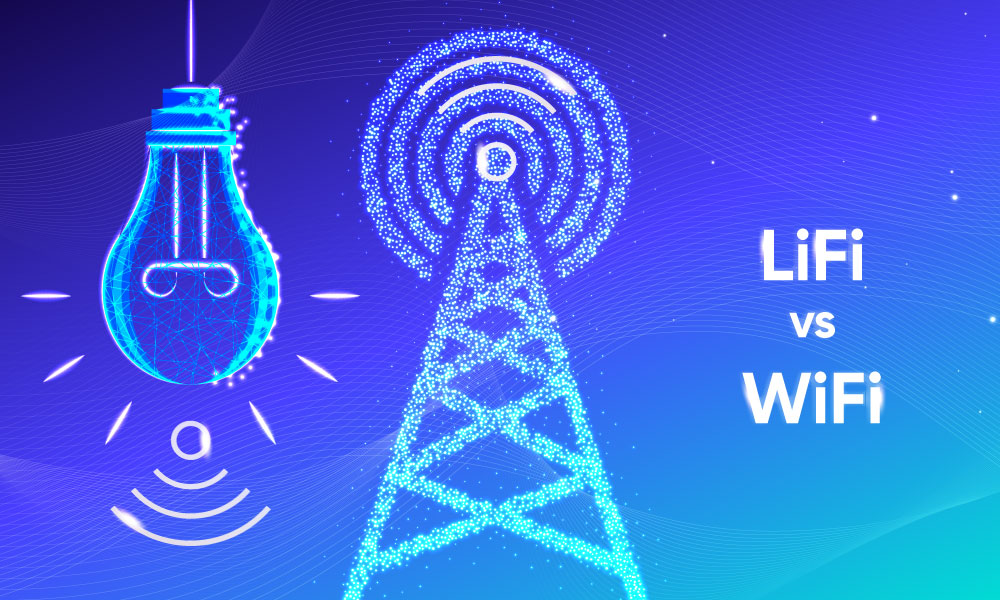
The difference has important consequences. Radio signals can pass through many common building materials, allowing Wi-Fi coverage to extend beyond a single room. Light behaves differently. It can be blocked by walls and solid objects, creating smaller communication zones.
That limitation can become an advantage in environments where signal containment matters. A LiFi network can potentially deliver connectivity within a defined area without allowing the same signal to travel freely through surrounding rooms.
revolvertech highlights this distinction as one reason LiFi should not necessarily be viewed as a direct replacement for Wi-Fi. Instead, the technologies can complement each other. Wi-Fi can provide broad mobility, while LiFi can deliver targeted connectivity where optical communication offers specific benefits.
Key Advantages of LiFi Internet
High Potential for Data Capacity
The optical spectrum is extremely broad compared with the radio spectrum used for many wireless communication systems. This creates substantial room for developing high-capacity optical communication technologies.
As connected devices continue multiplying, available wireless spectrum becomes increasingly valuable. Smart buildings, industrial sensors, augmented reality devices, autonomous equipment, and high-resolution media can all create substantial data requirements.
LiFi could help address this challenge by moving some wireless traffic into optical channels rather than forcing every device to compete for radio-frequency capacity.
Reduced Radio-Frequency Congestion
Modern environments can contain hundreds or thousands of connected devices. Smartphones, laptops, cameras, wearables, sensors, routers, and industrial equipment may all compete for wireless resources.
LiFi introduces another communication medium. Instead of adding more demand to already busy radio networks, organizations could use optical connectivity for suitable applications.
This approach could be particularly valuable in places where radio-frequency congestion creates operational challenges. Airports, manufacturing facilities, convention centers, and dense office buildings are examples of environments where alternative wireless channels may provide additional flexibility.
Improved Physical Signal Containment
Because light generally does not pass through opaque walls, LiFi communication can naturally remain within defined spaces. This characteristic may help organizations create localized connectivity zones.
For example, an office could theoretically use different optical access points in adjacent rooms without allowing the signal to travel through walls in the same manner as radio waves.
This does not automatically make LiFi completely secure. Encryption, authentication, device protection, and network management remain essential. However, the physical characteristics of optical transmission can contribute another layer to a broader security strategy.
LiFi Compared With Traditional Wi-Fi
| Feature | LiFi | Traditional Wi-Fi |
|---|---|---|
| Primary transmission medium | Light | Radio waves |
| Signal through walls | Generally limited | Often possible |
| Mobility | More localized | Strong across coverage areas |
| RF congestion | Can avoid RF spectrum | Uses radio spectrum |
| Signal containment | Naturally more localized | Wider propagation |
| Infrastructure | Lighting plus networking equipment | Wireless access points |
| Best potential use | Targeted, high-density environments | General-purpose wireless access |
| Dependence on illumination | Often relevant | Not required |
The comparison shows why neither technology has to eliminate the other. Their physical characteristics make them useful for different situations.
Practical Applications of LiFi
Smart Homes and Offices
LiFi could become part of future smart buildings where lighting infrastructure already covers large portions of indoor spaces. Ceiling lights could potentially provide both illumination and localized wireless communication.
In an office environment, desks positioned beneath optical access points could receive high-speed connectivity while conventional wireless networks handle broader mobility. Meeting rooms could use separate optical zones, helping distribute network traffic across different areas.
Smart lighting systems could also become more intelligent by combining communication, occupancy information, environmental sensors, and building-management functions.
Hospitals and Healthcare Facilities
Healthcare environments can contain sophisticated electronic equipment and require dependable communication. LiFi has attracted interest for situations where controlling radio-frequency transmissions may be beneficial.
Optical communication can also support location-specific connectivity. Medical devices, monitoring equipment, and mobile terminals could potentially communicate within carefully defined areas.
However, healthcare deployment would require rigorous testing, reliability controls, electromagnetic compatibility assessment where relevant, cybersecurity measures, and compliance with applicable safety standards.
Industrial Automation
Factories increasingly depend on connected machinery, robots, sensors, cameras, and real-time monitoring. These systems can generate large amounts of data and may operate in environments where reliable wireless communication is essential.
LiFi could provide targeted communication links between equipment in defined workspaces. Its localized nature could also help reduce interference between neighboring communication zones.
Industrial facilities could potentially combine optical and radio technologies, using each according to the movement requirements, physical layout, and data needs of particular machines.
Airports and Transportation Hubs
Large transportation facilities serve enormous numbers of connected devices. Passenger Wi-Fi, security equipment, digital signage, cameras, operational systems, and staff devices all compete for network resources.
Optical wireless communication could potentially provide additional connectivity in selected indoor areas. It could also be useful for location-aware services because an optical transmitter can create a relatively precise coverage zone.
Challenges That LiFi Must Overcome
Despite its potential, LiFi is not without obstacles. The most obvious challenge is line-of-sight or near-line-of-sight communication. A person, object, or piece of equipment positioned between a transmitter and receiver can weaken or interrupt the optical signal.
Ambient light is another consideration. Sunlight and artificial lighting can introduce optical noise, meaning systems need sophisticated receivers and signal-processing techniques.
Device integration is also important. Consumers cannot simply connect an ordinary Wi-Fi-only smartphone to a LiFi network without suitable optical communication hardware or an external accessory.
Other challenges include:
- Maintaining connectivity when users move around
- Designing efficient handover between optical access points
- Supporting communication when lights are dimmed
- Developing affordable compatible hardware
- Establishing broad interoperability
- Managing installation and maintenance costs
- Ensuring reliable performance under changing lighting conditions
These factors mean LiFi is more likely to develop as part of a hybrid connectivity ecosystem than as an overnight replacement for Wi-Fi.
The Role of LiFi in Edge Computing
Edge computing moves processing and decision-making closer to the devices generating data. This reduces the need to send every task to a distant cloud server and can improve responsiveness for applications that require rapid decisions.
LiFi could complement edge computing by providing localized, high-capacity wireless links between sensors, machines, edge servers, and user devices.

Imagine a smart factory where cameras monitor production equipment. Instead of sending every video stream across a crowded conventional wireless network, selected optical links could transport large data volumes toward nearby edge-computing infrastructure.
revolvertech sees this type of combination as particularly interesting because edge computing and LiFi both emphasize localized processing and communication. Together, they could support applications where low latency, high bandwidth, and controlled connectivity are important.
LiFi and the Future of Smart Cities
Smart cities depend on massive networks of sensors and connected infrastructure. Street lighting, traffic systems, public transportation, environmental monitoring, security infrastructure, and public services increasingly rely on digital communication.
LiFi could eventually become part of this ecosystem, especially in indoor public environments. Lighting infrastructure is already widespread, making it an interesting foundation for optical networking.
Future buildings could potentially use intelligent lights that provide illumination, communication, sensing, and positioning simultaneously. Rather than treating lighting as a passive utility, connected infrastructure could turn it into an active component of digital networks.
This vision could help reduce infrastructure duplication while creating new opportunities for indoor navigation, asset tracking, device communication, and location-based services.
Why Hybrid Networks May Win
The future of wireless connectivity is unlikely to be defined by one technology alone. Different communication systems have different strengths, and users increasingly expect seamless connectivity regardless of the underlying infrastructure.
A hybrid network could combine:
- Wi-Fi for broad indoor mobility
- LiFi for localized high-capacity communication
- Cellular networks for outdoor and wide-area connectivity
- Bluetooth for short-range personal devices
- Wired Ethernet for fixed high-performance connections
This approach allows organizations to select the most appropriate communication method for each application. A laptop moving through an office might transition between LiFi and Wi-Fi, while fixed equipment could use Ethernet and mobile users could depend on cellular connectivity outside the building.
What Businesses Should Consider
Organizations interested in emerging wireless technologies should evaluate LiFi based on practical requirements rather than assuming that newer automatically means better.
A useful assessment should consider:
- Network density: Determine whether existing wireless infrastructure is becoming congested.
- Data requirements: Identify applications that require high throughput or low latency.
- Physical environment: Evaluate lighting layouts, obstacles, windows, and room structures.
- Device compatibility: Check whether intended endpoints support optical communication.
- Security requirements: Examine whether localized signal coverage provides operational benefits.
- Hybrid integration: Consider how LiFi would work alongside existing wired and wireless systems.
Starting with a targeted pilot can be more sensible than replacing an entire network. Offices, laboratories, factories, and specialized facilities may provide suitable environments for testing the technology under realistic conditions.
The Future Outlook for LiFi
LiFi remains an emerging technology, but its underlying concept addresses several important trends in modern networking. Data consumption continues to grow, connected devices are becoming more numerous, and organizations are searching for additional ways to expand wireless capacity.
Future advances could improve receiver sensitivity, miniaturize communication components, increase mobility, and simplify integration with consumer electronics. Better standards and broader hardware support could also determine how quickly LiFi moves from specialized deployments into mainstream environments.
The strongest opportunity may not be replacing Wi-Fi but expanding the overall wireless ecosystem. By using light where light-based communication is practical and radio technology where it is more effective, future networks can become more flexible.
Conclusion
LiFi represents a compelling shift in how wireless communication can be delivered. By transforming high-speed LED lighting into a communication platform, the technology creates possibilities that extend beyond conventional radio-based networking. Its localized coverage, potential capacity, and ability to operate outside traditional Wi-Fi radio channels make it attractive for smart buildings, industrial automation, healthcare, transportation, edge computing, and other specialized environments. At the same time, limitations involving physical obstructions, device compatibility, mobility, ambient light, and deployment costs cannot be ignored.
The most realistic future is therefore a connected environment where LiFi and Wi-Fi work together rather than compete for complete dominance. revolvertech explores this broader perspective by recognizing that smarter connectivity will depend on combining multiple technologies according to their strengths.