


The connected home is evolving quickly. Smart televisions, security cameras, speakers, thermostats, appliances, gaming systems, smartphones, tablets, and work computers now compete for the same wireless connection. As the number of devices increases, traditional Wi-Fi networks can struggle with congestion, delays, and inconsistent performance. Wi-Fi 7 is designed to address many of these challenges by providing higher throughput, lower latency, greater capacity, and more intelligent use of available wireless resources. From a practical home-networking perspective, revolvertech highlights why the newest Wi-Fi generation matters for households that depend heavily on connected technology.
Wi-Fi 7, also known as IEEE 802.11be, introduces several improvements over previous Wi-Fi generations. Its purpose is not simply to make a single smartphone download files faster. Instead, the technology is designed to improve the overall experience when many demanding devices operate simultaneously. This makes Wi-Fi 7 particularly interesting for smart homes, where multiple devices may continuously send and receive information throughout the day.
Why Connected Homes Need Better Wi-Fi
A modern home network can contain dozens of connected products. Some devices consume very little bandwidth, while others demand substantial network resources. A 4K television streaming video, a cloud-connected security camera uploading footage, and a gaming console communicating with online servers can all operate at the same time.
Older wireless standards may handle ordinary usage well but become less efficient as network activity increases. Congestion can produce buffering, slow downloads, higher gaming latency, or delayed responses from smart devices. Wi-Fi 7 approaches the problem by increasing capacity and improving how data moves through the network.
Key reasons households may benefit include:
- More simultaneous connected devices
- Faster data transfers
- Improved responsiveness
- Better handling of network congestion
- Greater support for high-resolution streaming
- More reliable connections in busy wireless environments
For households planning a major smart-home expansion, choosing suitable networking technology can therefore be just as important as selecting the connected devices themselves.
Major Wi-Fi 7 Benefits for Smart Homes
Faster Wireless Performance
One of the most noticeable Wi-Fi 7 benefits is its potential for substantially higher wireless speeds. Wi-Fi 7 can use wider channels and advanced modulation techniques to transfer more data efficiently. The theoretical maximum performance is dramatically higher than previous generations, although actual household speeds depend on the router, client device, internet service, signal conditions, and configuration.
For everyday users, the advantage is less about reaching a theoretical maximum and more about having greater performance headroom. A household can download large files, stream high-quality content, synchronize cloud data, and use several connected devices without putting as much pressure on the wireless network.
revolvertech emphasizes that this extra capacity becomes especially valuable as homes increasingly combine entertainment, remote work, smart appliances, and connected security systems on one network.
Lower Latency for Responsive Devices
Speed and latency are not the same thing. A network may provide high download speeds while still experiencing delays when traffic becomes congested. Latency matters when immediate responses are important.
Wi-Fi 7 introduces improvements intended to reduce delays and make wireless communication more responsive. This can benefit online gaming, video conferencing, interactive applications, and smart-home controls.
Consider a connected lighting system. A user expects a command from an application or voice assistant to produce an almost immediate response. While individual smart-home commands generally require little bandwidth, a congested network can still affect responsiveness. A better wireless environment helps maintain smoother communication even while other devices are active.
Multi-Link Operation Improves Connectivity
Using Multiple Wireless Bands More Intelligently
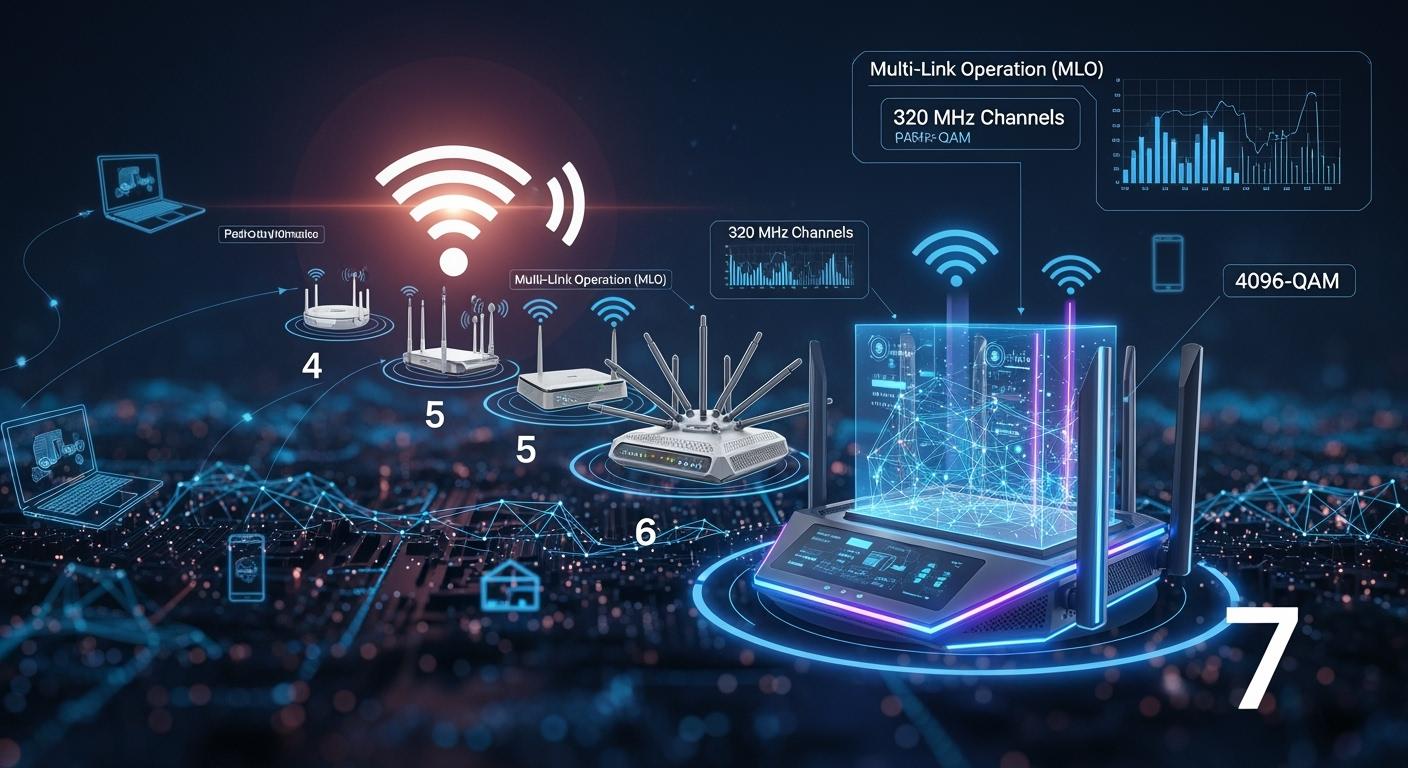
One of Wi-Fi 7’s important innovations is Multi-Link Operation, commonly called MLO. Instead of relying on a single wireless link in every situation, compatible devices can use multiple bands or links in coordinated ways.
This can improve throughput, reliability, or responsiveness depending on how the network and devices are configured. For example, a compatible device might take advantage of more than one available connection path rather than being restricted to a single band.
This feature is particularly relevant to busy homes because wireless conditions constantly change. Interference may affect one frequency while another remains relatively clear. Multi-link capabilities provide networking equipment with additional opportunities to manage traffic efficiently.
However, users should remember that both the router and client device need appropriate Wi-Fi 7 support to take advantage of these advanced capabilities.
Better Support for Multiple Connected Devices
Handling Smart-Home Congestion
A connected home is effectively a small digital ecosystem. A single household may have smart bulbs, plugs, cameras, speakers, appliances, laptops, phones, watches, televisions, consoles, and sensors operating simultaneously.
Wi-Fi 7 is designed with high-density environments in mind. Wider channels, improved resource management, and newer wireless technologies can help networks accommodate demanding traffic more efficiently.
For example, imagine a family evening when:
- One person is streaming a high-resolution movie.
- Another is playing an online game.
- A security camera is uploading video.
- Several smartphones are synchronizing photos.
- Smart speakers are playing music.
- A laptop is downloading a large software update.
A capable Wi-Fi 7 network can provide greater capacity for these simultaneous activities, reducing the likelihood that one demanding task will negatively affect another.
Wi-Fi 7 and 4K and 8K Streaming
High-resolution video requires considerable network capacity. Although modern compression technologies have improved efficiency, multiple high-quality streams can still place significant demands on a home network.
Wi-Fi 7’s higher potential throughput can help households move large amounts of data between compatible wireless devices. This is useful not only for internet streaming but also for local media servers, network-attached storage, and high-resolution content shared across devices.
A family using multiple televisions and streaming devices may particularly appreciate additional wireless capacity. Rather than focusing solely on the fastest possible connection for one television, Wi-Fi 7 provides a broader performance foundation for the entire household.
Improved Gaming Experiences
Speed Isn’t Everything for Gamers
Gaming performance depends heavily on latency, consistency, and network stability. A fast connection that suddenly experiences congestion can still create frustrating gameplay.
Wi-Fi 7’s emphasis on responsiveness and efficient traffic handling can make it attractive for gamers using wireless connections. Compatible equipment may provide a more consistent experience when other household members are simultaneously consuming bandwidth.
Cloud gaming could also benefit from better wireless performance because gameplay is highly dependent on continuous communication between the device and remote servers. While Wi-Fi cannot eliminate internet-service or server-side latency, a stronger local wireless connection can reduce one potential source of delay.
revolvertech views this as an important distinction: Wi-Fi 7 is not simply a speed upgrade. Its broader value comes from improving the way a busy home network handles different types of traffic.
Wi-Fi 7 for Smart Security Systems
Connected security cameras can generate continuous or event-based network traffic. Multiple cameras, video doorbells, smart locks, alarms, and monitoring systems can create a considerable wireless workload.
A Wi-Fi 7 network can provide more capacity for homes with numerous connected security devices. This is especially useful when cameras transmit high-resolution footage to local storage or cloud services.
A stronger network foundation can also support other security-related activities simultaneously. For example, homeowners might access a camera remotely while another camera is uploading footage and household members are using the internet normally.
Network security itself remains essential, however. Faster Wi-Fi does not automatically make a smart home secure. Strong passwords, updated firmware, encrypted connections, appropriate network segmentation, and careful device management remain important.
A Practical Wi-Fi 7 Comparison
The following table provides a simplified comparison of how Wi-Fi generations can differ in capabilities. Actual performance varies by hardware, environment, channel configuration, and client support.
| Feature | Wi-Fi 5 | Wi-Fi 6 | Wi-Fi 7 |
|---|---|---|---|
| Maximum theoretical speed | Lower | Higher | Significantly higher |
| 6 GHz support | No | Depends on Wi-Fi 6E | Yes |
| Multi-Link Operation | No | No | Yes |
| Wider channel capability | Limited | Up to 160 MHz | Up to 320 MHz |
| High-density efficiency | Good | Very good | Excellent potential |
| Advanced modulation | 256-QAM | 1024-QAM | 4096-QAM |
| Smart-home suitability | Good | Very good | Excellent for demanding homes |
This comparison should not be interpreted as a guarantee that every Wi-Fi 7 router will outperform every older router in every situation. Hardware quality, placement, interference, internet speed, and compatible devices all influence real-world results.
More Efficient Home Networking
Preparing for Future Devices
Another advantage of adopting Wi-Fi 7 is future readiness. Wireless technology is increasingly becoming the foundation for home computing. New devices are likely to demand more bandwidth and more responsive connections as applications become richer.
A household purchasing a new router today may want that equipment to remain useful for several years. Investing in a current-generation wireless platform can provide additional capacity for future devices.
revolvertech recommends thinking beyond today’s device count. A home that currently has 15 connected products could easily have 30 or more in the future. Planning for growth can prevent homeowners from repeatedly replacing networking equipment whenever their connected ecosystem expands.
What You Need to Benefit From Wi-Fi 7
Buying a Wi-Fi 7 router alone does not guarantee Wi-Fi 7 performance. The complete networking environment matters.
Before upgrading, consider:
- Whether your phones and computers support Wi-Fi 7
- Whether your internet plan provides enough bandwidth
- Whether your router supports the desired wireless bands
- The size and layout of your home
- Potential sources of wireless interference
- Wired Ethernet options for stationary devices
- Router placement and antenna coverage
If most devices in a home use older Wi-Fi generations, the benefits of upgrading may initially be limited. However, Wi-Fi 7 routers can still provide a strong foundation as compatible devices are gradually introduced.
Wi-Fi 7 and the Future of Connected Living
The smart home is moving toward more continuous and data-intensive connectivity. Artificial intelligence features, high-resolution cameras, immersive entertainment, cloud applications, smart appliances, and connected workspaces are all contributing to higher network demands.
Wi-Fi 7 is positioned to support this transition by combining higher throughput with better responsiveness and multi-device efficiency. Its value becomes particularly clear when the network is treated as shared infrastructure rather than a simple method for connecting a single computer to the internet.
A well-designed Wi-Fi 7 network can help create a smoother foundation for multiple categories of connected technology. revolvertech sees this broader network capacity as one of the most important reasons homeowners should understand Wi-Fi 7 before making their next networking investment.
Making the Most of a Wi-Fi 7 Upgrade
A successful upgrade involves more than purchasing the newest router. Placement, configuration, device compatibility, and network planning all matter.
Homeowners should place the router in a relatively central and open location rather than hiding it inside a cabinet. Firmware should remain updated, and unnecessary interference should be minimized. High-bandwidth stationary devices can also use Ethernet where practical, leaving wireless capacity available for mobile and smart-home devices.
It is equally important to identify which devices actually require advanced wireless performance. A smart temperature sensor may need almost no bandwidth, while a gaming PC, media server, or high-resolution streaming device can benefit much more from improved network capacity.
Conclusion
Wi-Fi 7 represents a significant step forward for home wireless networking. Its combination of higher potential speeds, wider channels, improved modulation, Multi-Link Operation, lower latency potential, and stronger support for high-density environments makes it particularly relevant to increasingly connected households. The biggest benefit is not necessarily that one device can reach an impressive speed-test number. The more meaningful advantage is the ability to support a growing collection of demanding devices while maintaining a smoother and more responsive network experience.